D A V I S
E N G L I S H
קישורים
A. The beginnings of writing
The earliest forms of writing were not really writing as we know of them today. They were paintings, art. It seems that wherever there is a blank surface, people have been scratching, drawing, scribbling, spraying graffiti, whatever (Wilford 2014, Robson 2014). Those images have meaning; something with meaning is a form of communication, and therefore, even the most basic forms of imagery are a form of writing. A writing system is a visual notation system in which a repertoire of marks, or strokes, is used to form a repertoire of characters (Changizi & Shimojo, 2005). It is claimed that the earliest example of written communication was found in the Chauvet Caves near Vallon-Pont-d'Arc in France; amazingly, this dates back some 30,000 years (Hills 2016). As soon as a child can hold a writing instrument and has a writing surface, they are going to scribble something. How many parents have had to suffer cleaning of the walls of their homes from the scratchy doodling of a child?!
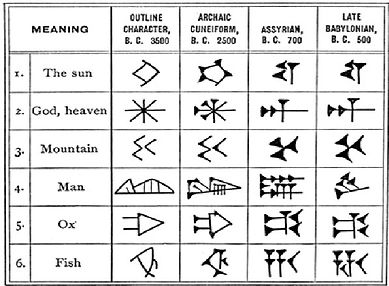
Let us jump 25,000 years (to about 3200 BCE), and a continent, and we can see that the Sumerians living in southern Mesopotamia had the beginnings of a writing system (Mark 2018) known as cuneiform (pronounced /kjuːˈneɪɪfɔːm/), although proto-writing systems predate this by maybe 4000 years (Gross 2012). Cuneiform is considered to be one of the earliest systems of writing. Cuneiform writing was made by forming wedge-shaped marks on clay tablets using a reed as a pen (a stylus). Words in cuneiform developed gradually from simple pictographs to more sophisticated symbols. You can see the development of different words here:
The historian Paul Kriwaczek (2010 p. 63) wrote that although the cuneiform system was more advanced than the pictograph system, it still lacked the capabilities of a proper writing system:
“All that had been devised thus far was a technique for noting down things, items and objects, not a writing system. A record of `Two Sheep Temple God Inanna’ tells us nothing about whether the sheep are being delivered to, or received from, the temple, whether they are carcasses, beasts on the hoof, or anything else about them”.
Other writing systems developed in other parts of the world at similar times as well. Egyptian hieroglyphs emerged at about 4,000 BCE from the preliterate artistic traditions of Egypt (Jilozian 2010). The Egyptians created their own written language using images to express words and numbers, just like other cultures did. Although the Sumerians and the Egyptians must have known of each other’s cultures, it does not seem that their writing systems are connected because the two scripts are entirely different (Dorman & Hellmut 2019). Chinese is another great and ancient writing system; it emerged around the 2nd millennium BCE. It seems that the Chinese also developed from pictographs. The earliest known Chinese texts contain between 10 and 60 characters, and by about 1400 BCE, the script included some 2,500 to 3,000 characters, most of which would be recognisable to a Chinese reader today. Chinese is a more complex writing system than others. Here is a concise and comprehensive explanation taken from the Encyclopædia Britannica (Olson 2014)
“Although it was possible to make up simple signs to represent common objects, many words were not readily picturable. To represent such words the phonographic principle was adopted. A graph that pictured some object was borrowed to write a different word that happened to sound similar. With this invention the Chinese approached the form of writing invented by the Sumerians. However, because of the enormous number of Chinese words that sound the same, to have carried through the phonographic principle would have resulted in a writing system in which many of the words could be read in more than one way. … The solution to the problem of character ambiguity, was to distinguish two words having the same sound and represented by the same graph by adding another graph to give a clue to the meaning of the particular word intended. Such complex graphs or characters consist of two parts, one part suggesting the sound, the other part the meaning”.
Another interesting ancient writing system is the Maya glyphs. The earliest text discovered dates to the 3rd century BCE. According to Campbell & Kaufman (1985), “Mayan writing began with strictly logographic signs, which have the value of whole morphemes”, as did cuneiform and the Egyptian hieroglyphs, and these were later complemented with syllabic symbols, glyphs, like we can find in modern-day Japanese and Chinese.
B. What's the picture today? How do we read?
Most writing systems today are not pictorial; they are not based on pictograms or logograms, but use alphabets. The Latin alphabet was adapted by the Etruscans in about 600 BCE and has origins in the Greek and ultimately Phoenician alphabet. (Gordon 1969). The Latin alphabet initially spread across the world alongside Christianity and soon displaced Early Medieval alphabets such as the Irish Ogham and the Runes of Germany and Scandinavia. The Latin alphabet continues to spread, and it is by far the most dominant in the world. Many countries, even in modern times, have adopted the Latin alphabet (Spread of the Latin script n.d.), which is associated with technological advancement and westernisation. For example, in 1928, Turkey replaced the Ottoman Turkish alphabet with the Latin alphabet as part of the cultural reforms of the period.
The disadvantages of a pictorial-based writing system are numerous, and it is no wonder that most people in the world do not use them. There can be so many symbols in a writing system using logograms that they can be simply overwhelming. The complexity of such a system is difficult for learners (foreigners and children) to grasp. For some, there is no connection between the character and its pronunciation, so it becomes nearly impossible when writing foreign words or names. And, of course, printing is a challenge. Logogram systems do have some advantages, though, such as the ability to read much faster, as they often neatly convey complex concepts with just a few symbols. Personally, I think that the peculiarity and complexity of a language are part of its beauty and languages such as Chinese and Mayan qualify!
The other common writing system is the alphabet. Some alphabets are classified as abjads in which the letters predominantly represent consonants (Fromkin & Hyams 2011), eg, Arabic, Hebrew and some other West Semitic languages. Others are abugidas in which consonant-vowel sequences are written as a unit (some scripts of South and Southeast Asia, Semitic Ethiopic scripts, and Canadian Aboriginal syllabics). Abjads are rare, and abugidas even more so; most languages so categorised do not use them purely (Bright 1999) (eg, Hebrew has a separate vowel system, the “dots”). Alphabets are a set of letters or symbols in a fixed order used to represent the basic set of speech sounds of a language (Alphabet [Def. 1]); they are the phonemes of a language. That is actually not a very good definition! Some written languages are a precise reflection of a people's speech, while others, like English, are messier (Diamond 1994). English uses an alphabet, but English spelling is, of course, totally awful (as is French). English could almost be considered to be a logogram language because there is so little connection between the letters put into a word and its sound (or meaning); in effect, the word is an abstract symbol (just think of height, colonel, knead, Wednesday, receipt, island). But native English speakers will never change to a more phonetic system precisely because the current complex one is easier and quicker to use (Carey 2016)!
Alphabets are very practical, so there are good reasons why so many (most) languages use them. Most alphabets are not difficult to learn (even Chinese children learn Chinese in the ABC before Mandarin characters (Rayner 2002)). Each letter in the alphabet represents, more or less, a sound, a phoneme; so many morphemes and words can be made by shuffling the letters around. Alphabets are usually also nice and neat, each shape is small, different and provides the reader with so much information. Typing and printing, especially on-screen, are just easier with alphabets. With just about 26 letters in English 171,476 words can be formed (and those are the words in current use) (Oxford).
C. Reading language
What would a writing system be worth without reading!? Shakespeare, Dickens, and Joyce could write and write, and no one would enjoy their output. Fundamentally, we write so that other people can read our works (shopping lists, plays, speeches, whatever). I stated above that writing seems to be an instinct; this is not the case for reading. Our brains seem to be good at acquiring oral language skills (you do not need to teach a baby to speak), but literacy skills must be learned through explicit instruction (Rayner 2002). Reading is a difficult skill that needs to be taught to the illiterate. Ideally, “the illiterate” are young children in 1st grade learning their letters. Teaching adult illiterates is a difficult task; teaching youngsters is marginally easier. The importance of reading cannot be underestimated; it is essential in language learning (Chio, Kit U 2009, Day 1998, Elley & Mangubhai 1983, Mikulecky 2008) and, in particular, in the acquisition of the L2.
Rayner (2002) contains a fascinating study of how best to teach reading and how politicians and academics clashed over pedagogic policy. There are three general approaches.
-
Whole word instruction. Here, children are introduced to words as wholes rather than taught the letters and their corresponding phonemes. They learn to recognise words as whole units. The word is the minimum unit of meaning and the essence of reading.
-
Phonics. This is considered an older method of teaching reading. Here, children are “taught how to use their knowledge of the alphabet to sound out words” (Rayner). But English is a relatively difficult language in that the letters don’t always play fair: c can be an s or a k, or gh is sometimes an f and sometimes silent. Nevertheless, there is a connection between letters and phonemes in most words and this generally facilitates the teaching of reading.
-
Whole-language. This method is also known as literature-based instruction or guided reading. Rayner explains that “the lack of perfect correspondence between letters and sounds is a source of confusion and a potential roadblock for the beginning reader … many schools have adopted a different approach: the whole-language method”. The method has some similarities to “immersion teaching”. This is how Rayner describes it:
“The whole-language approach aims to make reading instruction enjoyable. One of its key principles is that the rules of phonics should not be taught directly. Rather the connection between letters and sounds should be learned incidentally through exposure to text”.
Parents, politicians (generally liberal politicians) and school management tend to prefer the whole-language method; it is so much fun, it gives power to teachers (who get to choose the texts), and it is advanced/modern. It has intuitive appeal. But the research, according to Rayner, shows that phonics is the superior method, and it is wrong to abandon it. Letters are the basic unit of reading and not words. Of course, children eventually read simple, common words instantaneously, without recourse to letters. Experience teaches us that teachers must first teach the phonetics, the letters, and later on, children can be immersed in the language. Penny Ur (1996 p. 136) agrees that regardless of the L1, be it a Latin-based alphabet or not, learners must be first taught the L2 letters and sounds to increase “phonemic awareness”
The teaching of reading English as a second language has its own peculiarities. Mikulecky (2008) writes that “Reading in English requires a set of thinking skills and attitudes that grow out of the spoken and written use of the English language”. Teaching an L2 requires a certain way of thinking in that language, and English is a prime example of this. Mere coding of the letters and words, even with a lexical understanding of those words, is insufficient; there are cultural nuances, such as idiomatic expressions, that need to be taught, and English is full of these. Mikulecky goes so far as to assert that “it is important to realise that learning to read effectively in a second language literally alters the learner’s cognitive structures and value orientations”. Although Mikulecky’s article is firmly grounded in the theory of reading instruction, she offers excellent advice for the L2 teacher. The following is a summary of that advice.
-
We want pupils to be able to decode at speed, to be fluent. So, the text must be appropriate for the pupils' level. A gradual progression to harder texts should be made.
-
Some information about the topic of the text should be given before reading to ensure smoother understanding. The pupils themselves should be encouraged to identify the genre and the topic before starting to read. Background knowledge is an important factor in developing reading comprehension. It plays a dynamic role in text comprehension, and its absence can negatively affect reading comprehension (Hudson 2007). Clues such as the title and keywords can be so useful.
-
Encourage pupils not to get stuck on a hard word unless this word really impedes understanding. Ur (1996, p. 144) says that although checking unknown vocabulary is good for vocabulary expansion, it can be counterproductive to fluency (which is the goal).
-
Pupils must read a lot (Krashen 1985). Practice improves proficiency. Above all, the teacher must choose texts that pupils will enjoy. This will encourage more reading. Ur (1996, p. 146) and Mikulecky call this “extensive reading”.
-
For advanced students (11 and 12 grades and post K12), reading should be taken to a higher level (Bosley 2008). Critical or academic reading is a key component of studying. Higher-level reading varies widely and is not taught explicitly. Examples of this include teaching pupils to find the thesis sentence in each paragraph and to critically appraise the texts.
References
Alphabet [Def. 1]. (n.d.). Oxford Dictionary. Retrieved 26 June 2019, from https://www.lexico.com/en/definition/alphabet
Bright, William (1999) A Matter of Typology: Alphasyllabaries and Abugidas Source: Written Language & Literacy, Volume 2, Issue 1, Jan 1999, p. 45 - 55 DOI: https://doi.org/10.1075/wll.2.1.03bri
Bosley, L. (2008). "I don't teach reading": Critical reading instruction in composition courses. Literacy Research and Instruction, 47(4), 285-308
Campbell, L & Kaufman, T. (1985) Mayan Linguistics: Where Are We Now? Annual Review of Anthropology. Vol. 14:187-198. https://doi.org/10.1146/annurev.an.14.100185.001155
Carey, Stan (2016) A brief history of English spelling reform. History Today. https://www.historytoday.com/brief-history-english-spelling-reform
Changizi, Mark A. & Shimojo, Shinsuke (2005) Character complexity and redundancy in writing systems over human history. The Royal Society. Published 4 February 2005. https://doi.org/10.1098/rspb.2004.2942
Chio, Kit U (2009) Reading and Second Language Acquisition. HKBU Papers in Applied Language Studies Vol. 13, 2009
Day, R. R., Bamford, J., Renandya, W. A., Jacobs, G. M., & Yu, V. W.-S. (1998). Extensive Reading in the Second Language Classroom. RELC Journal, 29(2), 187–191. https://doi.org/10.1177/003368829802900211
Diamond, Jared (1994) Writing Right. Discover Magazine. June 1994. http://discovermagazine.com/1994/jun/writingright384
Dorman, Peter F. & Brunner, Hellmut (2019) Hieroglyphic writing. Encyclopædia Britannica. March 21, 2019. URL: https://www.britannica.com/topic/hieroglyphic-writing
Elley, W. B., & Mangubhai, F. (1983). The impact of reading on second language learning. Reading Research Quarterly, 19(1), 53-67. http://dx.doi.org/10.2307/747337
Fromkin, V., Rodman, R., & Hyams, N. M. (2011). An Introduction to Language - 9th (international) edition. Boston, MA: Thomson Wadsworth.
Gordon, A. (1969). On the Origins of the Latin Alphabet: Modern Views. California Studies in Classical Antiquity, 2, 157-170. doi:10.2307/25010586
Gross, Michael (2012) The evolution of writing, Current Biology, Volume 22, Issue 23, 2012. http://www.sciencedirect.com/science/article/pii/S0960982212013760
Hills, Thomas T. (2016) The Evolution of the Written Word. Psychology Today. https://www.psychologytoday.com/intl/blog/statistical-life/201612/the-evolution-the-written-word
Hudson, T. (2008). Teaching Second Language Reading. ELT Journal. 63. 10.1093/elt/ccn061.
Jilozian, Edward (2010) The Veil of Isis. June 2010, USA
Krashen, S. (1985) Insights and Inquiries, Alemany Pr August 1985
Mark, Joshua J. (2018) Cuneiform Definition. Ancient History Encyclopaedia. https://www.ancient.eu/cuneiform/
Kriwaczek, P. (2012) Babylon: Mesopotamia and the Birth of Civilization. Thomas Dunne Books March 2012
Mikulecky, Beatrice (2008) Teaching Reading as a Second Language in Reading Power. https://www.scribd.com/document/333093730/Teaching-Reading-in-Second-Language
Olson, David R. (2014) Chinese writing. Encyclopædia Britannica. https://www.britannica.com/topic/Chinese-writing 14 March 2014
Oxford (n.d.) How many words are there in the English language? Oxford Explore. https://www.lexico.com/en/explore/how-many-words-are-there-in-the-english-language
Oxford (n.d.) Does English Have More Words Than Any Other Language? Oxford Explore. https://www.lexico.com/en/explore/does-english-have-most-words
Rayner, Keith & Foorman, Barbara & Perfetti, Charles & Pesetsky, David & Seidenberg, Mark. (2002). How Should Reading be Taught? Scientific American. 286. 84-91. 10.1038/scientificamerican0302-84.
Robson, David (2014) Are we hardwired to doodle? BBC Future. 1 October 2014. http://www.bbc.com/future/story/20140930-are-we-hardwired-to-doodle
Spread of the Latin script (n.d.). In Wikipedia. Retrieved 27 June 2019 from https://en.wikipedia.org/wiki/Spread_of_the_Latin_script
Ur, Penny (1996) “Teaching reading”, Chap. 10 in A Course in English Language Teaching. Cambridge University Press; April 2012
White, Laurie J. (n.d.) Cuneiform and How Writing Developed. The Shorter Word. https://www.theshorterword.com/cuneiform
Wilford, John Noble (2014) Cave Paintings in Indonesia May Be Among the Oldest Known. The New York Times. https://www.nytimes.com/2014/10/09/science/ancient-indonesian-find-may-rival-oldest-known-cave-art.html